Tuesday, May 18, 2010

Is there a good fear?

In regards to a comment by "goforth"

That's a good question. According to Proverbs 9:10, there must be a good type of fear, but perhaps it is our word or definition of it that is limiting us. There is little good in our common cultural definitions for the word fear ... I think. We're afraid of many things: spiders, getting sick, death, public speaking, breaking a hip, losing a loved one, being in a bad place at a bad time. Though I've heard people say that there is a 'good type of fear'. Or I've heard the term to 'instill some fear' in them. Like when a child is hurt (not badly) but then learns that what they did had potentially painful consequences, we feel that to 'instill' this type of 'fear' is a good thing. Though I think we also call this a respect. Then you begin to respect that which caused you pain or could cause you pain. I respect the hot element and choose to create limits and boundaries on how I interact with a hot stove by not putting my body too close to it. I understand that it will do me damage and I value my body too much to do so. At some point I had to learn this and make a decision to do so. This is healthy and I think we do it all the time. And I think we also do this in relationships as well. We begin to choose to act and interact with people or different types or kinds of people in ways we think that are appropriate or loving ... or not. And one is a healthy respect and the other is not a healthy respect or fear, if you want to call it that. In a sense, I guess it could be much like coming to know yourself in relation to someone. So, culturally, I might decide that it is good for me to respect someone who is older than me because of the potential wisdom they might have or share with me and because, despite their age, they have a lot to offer to me potentially. And as I get to know this older person, I might find that what I thought might be true IS true and that I do learn from them and my respect grows all the more ... my understanding of my relation to them grows truer, as it were. I think this is something akin to the 'fear of the Lord'. That as we begin to understand our relation to Him and His to us, that is, His true character and our true character, our respect (or fear) grows more 'true'. More to what it should be. I would call someone a fool who disregarded the relationship of someone who could have given great benefit to them. But to grow in understanding of God is to grow in understanding in how to relate and befriend Him and to have that true 'fear' or respect or clear picture of the relational connection with Him. God is not one to be trifled with for sure. I'm kind of working this out as I write, not sure if it is making sense. Anyone agree?

Saturday, February 06, 2010

The Perception of Fear

I spoke on a passage of scripture I've never heard spoken on before: one that had to do with Jesus casting out a demon ... demons, actually. Out of the fellow commonly referred to as 'Legion'. Though in the passage we get the perception it's the many demons speaking through the man, not the man himself.


Anyway, this passage is found in Mark 5:1 - 20 (and versions of it in the books of Matthew and Luke) in the good old Bible. One of the many things that I found rather surprising was the response the demons have to Jesus just prior to their expulsion from the man. First off, it's important to know that they are very afraid. Very afraid. This is their response to Jesus when they see him: "What do you want with me, Jesus, Son of the Most High God?" Shouting at the top of his voice. "Swear to God ..." Uh ... isn't Jesus God? "... that you won't torture me! ... And he begged Jesus again and again not to send them out of the area." It's interesting to note that the demons are anticipating torture. Now, let me ask you a question. Is the God you know (if you know Him) a God who tortures others? Is he known for his torturing techniques ... His sweet revenge? Does He take delight in bringing pain intentionally on others? Does He like to torture someone?

Now, you might be thinking to yourself: 'well ... no, but hey, these are demons! They deserve it and God's o.k. with torturing demons'. Does he? First of all it's not God, but Jesus who is being expected to torture here. Does Jesus torture anyone while on earth that you know of??

What I find most interesting is that we see the demons expecting torture. I do not know Jesus as a God who tortures anyone. He grants what we request or He doesn't. But He's loving and just. He even grants the demons a compromise and lets them jump into some pigs. Why doesn't Jesus just get 'em right there!! He's got them by the short and curlies! But he lets them beg and allows them their compromise. Interesting. And I find it interesting that the demons really do not know or understand the nature of Jesus. And therefore God. They don't know him. They expect punishment. They think that Jesus treats others they way they treat others - with pain and torture (it's what they had been doing to the man they inhabited). Which is true of people as well. We usually expect to get some serious punishment because we know when we deserve something nasty. But God is NOT a God who treats us as our sins deserve. Satan does NOT understand this. He does NOT get it. He does not know or understand God's character. He is a control freak and cannot see or know any other character except the character through which he operates, which is usually also how we operate. This is what fear does to people. It removes our understanding of God's true character and nature. And yet 'There is no fear in love. Perfect love drives out fear.' 1 John 4 somewhere.

Fear is a destroyer of truth.

Tuesday, January 26, 2010

Ordination

So, what is the point of ordination ... anyway? A little over a year ago I was asked to officiate a wedding for a young couple who have served us at Camp Squeah. I felt privileged and wanted to support them in this way. It was a wonderful experience and I truly felt the good weight of solemnity and importance of the covenant and commitment that marriage is through that experience. I loved it!! And I got to rejoice with this young couple.

Since then I've been asked to do a number of other weddings including my mother-in-law's (she has been twice widowed) and my brother-in-law (my wife's only brother). It has been an incredibly rich experience in every case. My wife and I are encouraging another young couple in their journey to become married, now engaged, as I will also officiate their wedding this coming May. I'm allowed to do so by requesting a temporary license to marry through the Camp denomination through which I am considered clergy through my title/position. It's a neat perk (to some) and I've taken advantage of it. Through this experience I started wondering about the process of ordination and asking what exactly it is. I've received a variety of responses in my search. Some think it's rather useless ... like testing someone in geography when they've already traveled the world, and others think it's imperative - the only true sign of a committed worker in God's Kingdom.

I'm still wrestling (in a good way) as I walkt the path to become ordained. The really cool thing (in my opinion) is I'll get to essentially be clergy for two denominations at the same time (Mennonites of British Columba and the Nazarene's). The positive implications are I get to take a few classes in theology and biblical studies that I've never had the chance to (never been to a bible college) and I'm pumped to dive into this and write a few papers ... which is weird because I don't usually like writing papers. Plus I get the benefit of having a whole denomination keeping me accountable for my actions as a minister of Jesus. Though in truth I already am and have been for a good chunk of my life.

So what is Ordination? It's considered a sacrament to the Catholics. I have likened it to the wedding ceremony and the baptism ceremony as well ... though the analogies don't always quite transfer. But if the wedding is the agreement of the community and the church that what the couple have ALREADY chosen to do and be to each other is right and good ... and baptism is the symbolic assertion and confession of faith that is ALREADY alive and active in a believer, then it seems reasonable to view ordination as the careful & thoughtful recognition of a believer by the community of the church as an ALREADY committed worker/minister in God's Kingdom. The implication in all these statements is that what they are agreeing to that is good has already happened - marriage, salvation and ordination. So, in honesty and humility I am committing myself to the journey of ordination through the Nazarene's, not because I don't think I'm ordained (I believe I am), not to become a pastor or worker in a church institution (I am committed to and love being a program director at a camp), but to grow deeper in my faith and understanding of my part in the Kingdom and to learn more of this mystery called faith in the Life of Christ and to seek to tie myself closer with other Christians both for accountability but for loving support and encouragement for the rest of my life. This is an encouraging thought.

So ... what do you think of ordination?

A return to blogging

Hello blog lovers and readers,

My apologies for the extended hiatus from blogging. My life is full and this is a good thing ... for the most part. I will begin blogging again and I would love to continue to hear your thoughts as I explore and discover the mystery of the great thing called life. And this great person called Jesus.

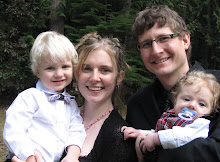
Over the last few months a lot has happened. My oldest son (Griffin) turned 3 years old. He's now truly testing the limits of our sanity and our love and he seeks to know that we care for him even when he chooses (continually) to NOT eat his food at the dinner table :). He has also, miraculously, begun using the toilet! How this happens I'm not certain but essentially from one day to the next he goes from refusing to the fiber of his being to choosing to empty the fiber from his being into a proper waste disposal system. Hallelujah.

Maerk turned 1 in November and is loving life. He's getting more teeth ... again. He has lots of words, but none of them are in English. Well, very few of them, anyway. He certainly enjoys making sounds. Sometimes he'll talk whole sentences without opening his lips. It's like trying to read muted tonal inflections. VERY difficult. He's a cutie.

Kari is doing well - ever the beautiful and wonderful woman I've loved and grow to love. She continues to sew her baby sleeping bags for people (if you're interested, let me know!). She has helped in facilitating a number of great book studies for friends and other women in town and has had a great time doing that. Among the books they've studied are Dr. Laura's 'The Proper Care and Feeding of Husbands' (very good book) and a book study on Esther called 'Esther'. Not sure who writes that one. We're also still having people over regularly for open house brunch potlucks once a month and whatnot.

Personally, I've jumped into a few different things over the last little while. Along with being a member of our local fire department I have been helping to organize the British Columbia Camping Conference this coming week, becoming a member of the BCCA executive taking the position as Accreditation Chair for all summer camps in BC (with some help), moving forward in becoming an ordained minister through the Church of the Nazarene and otherwise working my buns off for Camp Squeah with everything we do through this time of the year.

Christmas was great. We spent it at home and enjoyed a relaxing time together as a family.

Posts are a comin'!

Monday, November 02, 2009

The need for a mixture

I found these few statements on the maturation process of children to be quite interesting. What do you think? This is taken from "Hold Onto Your Kids; Why Parents Matter" by Gordon Neufeld & Gabor Mate:


"Maturation in the psychological realm involves the differentiation of the elements of consciousness - thoughts, feelings, impulses, values, opinions, preferences, interests, intentions, aspirations. Differentiation needs to happen before these elements of consciousness can be mixed to produce tempered experience and expression. It is the same in the realm of relationships: maturation requires that the child first becomes unique and separate from other individuals. ... More fundamentally, a sense of self first needs to separate from inner experience, a capacity entirely absent in the young child. The child has to be able to know that she is not identical with whatever felling happens to be active in her at any particular moment.


... Without the capacity for reflection, they [two immature children] were defined by the inner experience of the moment. They immediately acted out whatever emotions arose in them. They could be their inner experience, but they could not see it. This inability made them impulsive, egocentric, brazen, dogmatic, reactive and impatient. Because fear did not mix with hope, there was no courage. Because frustration did not mix with caring, there was no patience. Because anger did not mix with love, there was no forgiveness. Because frustration did not mix with either fear or affection, they lost their tempers. In short, they lacked the fruits of maturation in their lives."


I find this thought that the mixing of many or more than one feeling at any one time as a tell tale sign of a mature individual is incredibly interesting. I work with and meet many a person who I find rather immature. This makes some interesting sense and is worth reflecting on some more.