Friday, September 03, 2010

The Lodge at Twin Creeks

My good (very good) friends, Pat and Peggy Wiens have opened an incredibly picturesque Bed & Breakfast/oasis/small retreat lodge on Sumas Mountain in Abbotsford BC. Set on 5 acres in old growth cedar country, it's the perfect place for a couple or small group to rest, reguvenate, begin a honeymoon or simply have a meaningful stay somewhere away from all that distracts. My wife and family have visited and it's beautiful! Bunnies, frogs, fruit trees, starry nights, blackberries and delectable breakfasts are all part of the enjoyment along with a choice of inimitable, cozy rooms, no two which are alike. I encourage any friends who might desire to get away to consider the Lodge at Twin Creeks. It's well worth the visit! Or visit them on their link below.

Sunday, August 29, 2010

A new Larson coming!

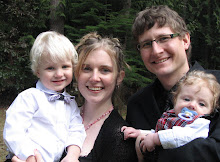
A new Larson is arriving soon! We will be expecting #3 sometime early next year we think. We're very excited for this new addition to the family.

The Larson 50/50 baby pool will again begin starting today! Here are the rules, simply stated! Get your guesses in early: Enter the contest by submitting a guess on a variety of categories related to the birth of our third child. Every guess is worth a $5.00 entrance fee up to a maximum of 3 guesses (that's $15.00 worth). A guess MUST include the weight (lbs, ounces), length (inches), date (month, day - I will add the proposed due date for everyone to give a guess ... so you know we've been 11 days and 2 days, respectively, so far), time (a.m. or p.m.), gender and the name (first and middle - we have names picked out for a boy or girl and we don't know the gender). With such a guess you are entered into the contest. Your guesses are only valid with the submittion of the entrance fee(s). The fees can come anytime up until the birth. Contest closes when the specifics are disclosed and the winner (whose combined guesses re closest to the truth) will receive half the winnings. The other half go to the child's education fund.
Submissions can be via e-mail: greyclad@gmail.com, phone: 604 860 4403, mail: #2 - 27915 Trans Canada Hwy, Hope BC, V0X 1L0, or submitted as a comment to this post below.

Thanks and happy guessing!

Thursday, July 22, 2010

Respect vs. Fear

That's a good thought Goforth.

I'm not sure where respect ends and fear begins and I certainly do not understand the cultural implications both spiritually and socially among 1st century Israel, which would lend some great insight to Jesus' words. But certainly there is a manner or kind of respect in every 'fear' we have. We acknowledge what we believe to be true about something and that belief then is what drives our behaviour towards it. So, very simply, I fear spiders. I don't really know why (though I could think of a few philisophical reasons) but I scream (a low manly scream, of course) when confronted with large specimens suddenly on my body or in my clothing. This fear is (without getting into how I got the fear) driven by my belief that they will do something to me - bite me, lay eggs, crawl around my skin without end. It is also driven by my perception of them, I think. They are so DIFFERENT and therefore I, perhaps, cannot trust THEIR behaviour. 8 legs, 8 eyes, soft hairy bodies, fangs, claws, sticky web spewing butts, paralyzing & blood sucking creatures. They have characteristics that much of what my culture would call evil. And so I believe this of them. Well however it is I believe it, I get pretty agitated pretty quick when I've got a wolf spider crawling up the inside of my shirt. Yet in my HEAD I know that much of what I fear about spiders is irrational. I still believe it because I still respond in a particular way. Fear is a powerful thing and long affects those infected by it. If I said I respect spiders, it would be true but my actions to this belief would be different. I think, though, there's often a little or a lot of both of these things going on in our minds and hearts when we consider God. Because we don't really know what He's like (kind of ... at least the Bible gives us some indications, though the definitions are often a little above us: God is love, spirit, life, light ...etc.). We can't see Him. We experience Him in ways ... but each person does so personally. So largely, I'd say, our belief of the character of God is determined by what we're taught by those we respect as such. That this belief will determine the type or amount or kind of fear/respect we have for Him. I'm feeling like I'm getting way off topic here. But I'm enjoying my rambling musing.

Tuesday, May 18, 2010

Is there a good fear?

In regards to a comment by "goforth"

That's a good question. According to Proverbs 9:10, there must be a good type of fear, but perhaps it is our word or definition of it that is limiting us. There is little good in our common cultural definitions for the word fear ... I think. We're afraid of many things: spiders, getting sick, death, public speaking, breaking a hip, losing a loved one, being in a bad place at a bad time. Though I've heard people say that there is a 'good type of fear'. Or I've heard the term to 'instill some fear' in them. Like when a child is hurt (not badly) but then learns that what they did had potentially painful consequences, we feel that to 'instill' this type of 'fear' is a good thing. Though I think we also call this a respect. Then you begin to respect that which caused you pain or could cause you pain. I respect the hot element and choose to create limits and boundaries on how I interact with a hot stove by not putting my body too close to it. I understand that it will do me damage and I value my body too much to do so. At some point I had to learn this and make a decision to do so. This is healthy and I think we do it all the time. And I think we also do this in relationships as well. We begin to choose to act and interact with people or different types or kinds of people in ways we think that are appropriate or loving ... or not. And one is a healthy respect and the other is not a healthy respect or fear, if you want to call it that. In a sense, I guess it could be much like coming to know yourself in relation to someone. So, culturally, I might decide that it is good for me to respect someone who is older than me because of the potential wisdom they might have or share with me and because, despite their age, they have a lot to offer to me potentially. And as I get to know this older person, I might find that what I thought might be true IS true and that I do learn from them and my respect grows all the more ... my understanding of my relation to them grows truer, as it were. I think this is something akin to the 'fear of the Lord'. That as we begin to understand our relation to Him and His to us, that is, His true character and our true character, our respect (or fear) grows more 'true'. More to what it should be. I would call someone a fool who disregarded the relationship of someone who could have given great benefit to them. But to grow in understanding of God is to grow in understanding in how to relate and befriend Him and to have that true 'fear' or respect or clear picture of the relational connection with Him. God is not one to be trifled with for sure. I'm kind of working this out as I write, not sure if it is making sense. Anyone agree?

Saturday, February 06, 2010

The Perception of Fear

I spoke on a passage of scripture I've never heard spoken on before: one that had to do with Jesus casting out a demon ... demons, actually. Out of the fellow commonly referred to as 'Legion'. Though in the passage we get the perception it's the many demons speaking through the man, not the man himself.


Anyway, this passage is found in Mark 5:1 - 20 (and versions of it in the books of Matthew and Luke) in the good old Bible. One of the many things that I found rather surprising was the response the demons have to Jesus just prior to their expulsion from the man. First off, it's important to know that they are very afraid. Very afraid. This is their response to Jesus when they see him: "What do you want with me, Jesus, Son of the Most High God?" Shouting at the top of his voice. "Swear to God ..." Uh ... isn't Jesus God? "... that you won't torture me! ... And he begged Jesus again and again not to send them out of the area." It's interesting to note that the demons are anticipating torture. Now, let me ask you a question. Is the God you know (if you know Him) a God who tortures others? Is he known for his torturing techniques ... His sweet revenge? Does He take delight in bringing pain intentionally on others? Does He like to torture someone?

Now, you might be thinking to yourself: 'well ... no, but hey, these are demons! They deserve it and God's o.k. with torturing demons'. Does he? First of all it's not God, but Jesus who is being expected to torture here. Does Jesus torture anyone while on earth that you know of??

What I find most interesting is that we see the demons expecting torture. I do not know Jesus as a God who tortures anyone. He grants what we request or He doesn't. But He's loving and just. He even grants the demons a compromise and lets them jump into some pigs. Why doesn't Jesus just get 'em right there!! He's got them by the short and curlies! But he lets them beg and allows them their compromise. Interesting. And I find it interesting that the demons really do not know or understand the nature of Jesus. And therefore God. They don't know him. They expect punishment. They think that Jesus treats others they way they treat others - with pain and torture (it's what they had been doing to the man they inhabited). Which is true of people as well. We usually expect to get some serious punishment because we know when we deserve something nasty. But God is NOT a God who treats us as our sins deserve. Satan does NOT understand this. He does NOT get it. He does not know or understand God's character. He is a control freak and cannot see or know any other character except the character through which he operates, which is usually also how we operate. This is what fear does to people. It removes our understanding of God's true character and nature. And yet 'There is no fear in love. Perfect love drives out fear.' 1 John 4 somewhere.

Fear is a destroyer of truth.

Tuesday, January 26, 2010

Ordination

So, what is the point of ordination ... anyway? A little over a year ago I was asked to officiate a wedding for a young couple who have served us at Camp Squeah. I felt privileged and wanted to support them in this way. It was a wonderful experience and I truly felt the good weight of solemnity and importance of the covenant and commitment that marriage is through that experience. I loved it!! And I got to rejoice with this young couple.

Since then I've been asked to do a number of other weddings including my mother-in-law's (she has been twice widowed) and my brother-in-law (my wife's only brother). It has been an incredibly rich experience in every case. My wife and I are encouraging another young couple in their journey to become married, now engaged, as I will also officiate their wedding this coming May. I'm allowed to do so by requesting a temporary license to marry through the Camp denomination through which I am considered clergy through my title/position. It's a neat perk (to some) and I've taken advantage of it. Through this experience I started wondering about the process of ordination and asking what exactly it is. I've received a variety of responses in my search. Some think it's rather useless ... like testing someone in geography when they've already traveled the world, and others think it's imperative - the only true sign of a committed worker in God's Kingdom.

I'm still wrestling (in a good way) as I walkt the path to become ordained. The really cool thing (in my opinion) is I'll get to essentially be clergy for two denominations at the same time (Mennonites of British Columba and the Nazarene's). The positive implications are I get to take a few classes in theology and biblical studies that I've never had the chance to (never been to a bible college) and I'm pumped to dive into this and write a few papers ... which is weird because I don't usually like writing papers. Plus I get the benefit of having a whole denomination keeping me accountable for my actions as a minister of Jesus. Though in truth I already am and have been for a good chunk of my life.

So what is Ordination? It's considered a sacrament to the Catholics. I have likened it to the wedding ceremony and the baptism ceremony as well ... though the analogies don't always quite transfer. But if the wedding is the agreement of the community and the church that what the couple have ALREADY chosen to do and be to each other is right and good ... and baptism is the symbolic assertion and confession of faith that is ALREADY alive and active in a believer, then it seems reasonable to view ordination as the careful & thoughtful recognition of a believer by the community of the church as an ALREADY committed worker/minister in God's Kingdom. The implication in all these statements is that what they are agreeing to that is good has already happened - marriage, salvation and ordination. So, in honesty and humility I am committing myself to the journey of ordination through the Nazarene's, not because I don't think I'm ordained (I believe I am), not to become a pastor or worker in a church institution (I am committed to and love being a program director at a camp), but to grow deeper in my faith and understanding of my part in the Kingdom and to learn more of this mystery called faith in the Life of Christ and to seek to tie myself closer with other Christians both for accountability but for loving support and encouragement for the rest of my life. This is an encouraging thought.

So ... what do you think of ordination?

A return to blogging

Hello blog lovers and readers,

My apologies for the extended hiatus from blogging. My life is full and this is a good thing ... for the most part. I will begin blogging again and I would love to continue to hear your thoughts as I explore and discover the mystery of the great thing called life. And this great person called Jesus.

Over the last few months a lot has happened. My oldest son (Griffin) turned 3 years old. He's now truly testing the limits of our sanity and our love and he seeks to know that we care for him even when he chooses (continually) to NOT eat his food at the dinner table :). He has also, miraculously, begun using the toilet! How this happens I'm not certain but essentially from one day to the next he goes from refusing to the fiber of his being to choosing to empty the fiber from his being into a proper waste disposal system. Hallelujah.

Maerk turned 1 in November and is loving life. He's getting more teeth ... again. He has lots of words, but none of them are in English. Well, very few of them, anyway. He certainly enjoys making sounds. Sometimes he'll talk whole sentences without opening his lips. It's like trying to read muted tonal inflections. VERY difficult. He's a cutie.

Kari is doing well - ever the beautiful and wonderful woman I've loved and grow to love. She continues to sew her baby sleeping bags for people (if you're interested, let me know!). She has helped in facilitating a number of great book studies for friends and other women in town and has had a great time doing that. Among the books they've studied are Dr. Laura's 'The Proper Care and Feeding of Husbands' (very good book) and a book study on Esther called 'Esther'. Not sure who writes that one. We're also still having people over regularly for open house brunch potlucks once a month and whatnot.

Personally, I've jumped into a few different things over the last little while. Along with being a member of our local fire department I have been helping to organize the British Columbia Camping Conference this coming week, becoming a member of the BCCA executive taking the position as Accreditation Chair for all summer camps in BC (with some help), moving forward in becoming an ordained minister through the Church of the Nazarene and otherwise working my buns off for Camp Squeah with everything we do through this time of the year.

Christmas was great. We spent it at home and enjoyed a relaxing time together as a family.

Posts are a comin'!

Monday, November 02, 2009

The need for a mixture

I found these few statements on the maturation process of children to be quite interesting. What do you think? This is taken from "Hold Onto Your Kids; Why Parents Matter" by Gordon Neufeld & Gabor Mate:


"Maturation in the psychological realm involves the differentiation of the elements of consciousness - thoughts, feelings, impulses, values, opinions, preferences, interests, intentions, aspirations. Differentiation needs to happen before these elements of consciousness can be mixed to produce tempered experience and expression. It is the same in the realm of relationships: maturation requires that the child first becomes unique and separate from other individuals. ... More fundamentally, a sense of self first needs to separate from inner experience, a capacity entirely absent in the young child. The child has to be able to know that she is not identical with whatever felling happens to be active in her at any particular moment.


... Without the capacity for reflection, they [two immature children] were defined by the inner experience of the moment. They immediately acted out whatever emotions arose in them. They could be their inner experience, but they could not see it. This inability made them impulsive, egocentric, brazen, dogmatic, reactive and impatient. Because fear did not mix with hope, there was no courage. Because frustration did not mix with caring, there was no patience. Because anger did not mix with love, there was no forgiveness. Because frustration did not mix with either fear or affection, they lost their tempers. In short, they lacked the fruits of maturation in their lives."


I find this thought that the mixing of many or more than one feeling at any one time as a tell tale sign of a mature individual is incredibly interesting. I work with and meet many a person who I find rather immature. This makes some interesting sense and is worth reflecting on some more.

Wednesday, September 23, 2009

NHL statistics

I'm a bit of a statistic nut. When I was but a teenager I would sit and watch cars pass my house and I would mark down what colour they were. I had a bar graph to show the ratio of car colours on the road. Maybe I was more than a nut.

I've recently been interested to know what the make-up of the NHL is. This all comes from the official sites of the the NHL teams.

You might be interested to know that 56% of the NHL players are Canadian born while 23% are out of North America and 21% are from the USA. By the way, there are 954 players on team rosters currently. Of the 56% Canadian players 39% of THAT number are from Ontario, 17% from Alberta, 12% from Quebec, 11% from Saskatchewan, 10% from BC, 6% from Manitoba, 2% from Nova Scotia and the remaining 2% from Newfoundland and New Brunswick.

Of the 23% from other countries, the greatest number of NHL players in this category come from Sweden making up 22% of that statistic. The Czech Republic, Finland and Russia hold the next highest spots with 19%, 17% and 13%. Slovakia is next in line with 8% of the total international playes and then Germany with 5%. The few remain players come from a variety of countries - 5 from Latvia, 4 from Belarus, 3 from Denmark and Switzerland, 2 from the Ukraine, Slovenia and Kazakhstan. There is only 1 person from each of these countries currently on an NHL roster: Italy, Austria, Poland, France, Ireland, Lithuania, South Korea, South Africa, Brazil, Japan, Norway and Brunei. The fella from Brunei was raised in Alberta Canada and has the last name Adams which leads me to suspect that though he was BORN in Brunei (tiny Asian country near the equator) his parents could very likely have been Canadian already.

Some other interesting facts: The Philadelphia Flyers have the highest percentage of Canadian players on their roster - 80%. Pittsburgh Penguins have the highest % of American players - 39% of their total players are American. And the Florida Panthers have the highest % of international players - 40%. The New York Rangers are the only team's roster who's American and International players outnumber their Canadian players ... and that only by 1 - 8, 8 and 7. It is also interesting to note that there is quite the discrepancy in the number of players that any NHL team may have on their roster. While the Detroit Red Wings have 48 players on their roster, San Jose have only 19. It may be that teams chose to put players on their roster that they are still considering for their team for the coming year while others choose to limit to those they know they will play. Florida's website has two lists. One with 20 players (called their roster) and one with 48 (called 'In the System'). San Jose have 4 different lists on their site. Their Roster - 19, their Rookie Games Roster - 26, their Training Camp Roster - 29 and their 'In the System' Roster or all their prospects - 48. For the purposes of my statistics I took only players who were on what a team called their Roster. I did not include prospects intentionally.

Friday, September 04, 2009

What Does it Mean to be Human? part 2

Sorry for the delay. This post carries on from the one below and continues the conversation through the last number of posts. I hope that you'll continue reading and enjoying them. Our summer camp season was busy and full and we're glad to have some time to spend together as a family. So, here you go:

So what I tried to argue was that from the bible’s point of view, starting in Revelation, it looks like it’s coming back here. What do we do with John’s odd description of this New Jerusalem that’s as big as the cosmos, shaped like a cube – track that imagery through the Old Testament and John’s vision is that God is going to come and dwell in a cosmic holy of holies with us. And that’s what he’s always intended to do and that makes sense all the way through the biblical narrative. Ours is a God who comes to us. He built us this wonderful place Eden, which means ‘the light’ and his concern is, he wants to dwell here with us. That’s why in Genesis 1 seven times, unparalleled in the rest of the biblical text, seven times God says this place is good, and we say ‘We believe the bible and all God wants to do is burn it up.’ How do you put that together? You don’t. That’s why Romans 8 Paul can say creation groans waiting for its redemption. That’s why John 3:16, the verse we all know, ‘For God so loved the ... cosmos.’ And now ... you ... know ... why! It’s his palace! It’s his temple! And he cares profoundly about it. You can ask people, ‘Do you love the cosmos? If you don’t this morning’s a good morning to become a Christian.’ So when you’ve gone walking through this extraordinary country Canada, you’ve stood on the beaches of Tofino and you’ve watched those breakers roll in and your heart wells up within you – this is not a non-spiritual aberration. That welling up is exactly what God intended. You’re struck with the wonder and the beauty of the temple of the palace He has made. Try thinking through that imagery.

When I’m driving on my way to work to Regent in Vancouver and I see the mountains rising up and in my mind I think of them as the pillars supporting the canopy of God’s temple. It changes the way you see the world. And this might sound really goofy, but I was out raking the leaves about two weeks ago and I had this epiphany. I was overwhelmed with emotion as I looked at each one of these … have you ever looked at a single leaf? Each leaf – the colour! And the shape. And this is all by accident. No. The bible rejoices in this. That’s why you get the Psalmist just overwhelmed by the beauty of creation. But what’s happened in the Christian tradition ever since the second century is we’ve been wanting to leave this place, get away from it. That’s what Nietzsche so repudiated about Christianity. He hated Christianity for that reason – because it treated the body and this present world with contempt and you know what, Jesus would agree with him in that critique. And we’re living with Nietzsche’s influence because we have lost sight of the biblical view of creation. Why should God care less? Because THIS IS HIS PALACE!! It’s HIS TEMPLE! And he’s going to get it back whether by hook or by cross. This is my Father’s world; I rest me in the thought. Yeah! Some of you look as if I’m speaking heresy here. [some laughter] How can it be any other way? So go search the scriptures.

Wednesday, June 17, 2009

What Does it Mean to be Human? part 1

This is the next lecture by Rikk Watts carrying on from the posts below titled 'Why Should God Care Less?' I hope you enjoy these as well:

Ah, a couple of things, just as we commence: Uh, if you want to get some of the information on this material we went through yesterday at a rather rapid clip, it’s on the American Scientific Association Website – so the American Scientific Association. They have a web page and if you get to the main page, I think on the left side there’s a column, on that column they have something like theology/bible, click on that, and about halfway down you’ll see something with my name on it and I think it’s called ‘making sense of Genesis 1.’ Now it’s not a, um, it’s kind of halfway between popular level writing and academic. There is a footnote in there for those of you who are interested about halfway through where I list about 4 or 5 critical books and articles that draw on this Egyptian background. But I would imagine, as far as you’re concerned, most of what you want is in the body of the text.

What I’m going to talk about today you can also get from a book called ‘What Does it Mean to be Saved?’ edited by John Stackhouse. It’s a series of lectures from a Regent conference and mine is the lead article that rejoices in the title of ‘Restoration of the Image.’ Salvation is new creation is exodus or some such thing. So if you want to get some more information on today’s session, at least the first half, you can get it from me. So that’s where to get the info from if you don’t get it all written down and the second thing is: one of the things I say to students who come to Regent is that some point in your education one of your sacred cows is going to have to come under the axe. And of course, we all say ‘We don’t have all the truth’, we all say that readily UNTIL somebody actually touches a point, ha ha, where we disagree and suddenly we DO have the truth and so it becomes and interesting little moment, eh. But, um, at various points we have to decide: are we going to Pentecostal or Christian? Are we going to be Baptist or Christian? And because, um, unless we really do think we’ve got it all together, which none of us thinks we have, then that does mean there are places where we need to reconfigure our thinking. At some point it’s going to have to happen and so we might as well get used to that. So, theological study is not about going around and finding reasons for why I was right all along. Theological study is only to grapple with this stuff and the chances are there are going to be some things I’m going to have to learn. But this should not be a reason for panic, because my faith is not in my theological system. If it was it would be in my ability as Rikk Watts to understand the profound mystery of God. I think that gets very close to idolatry. My faith is not my ability to understand God and if we get to it in the second half of this morning’s session, I think that’s where Greek philosophy took us astray. And unfortunately western theology has often been more captive to that than we realize. No, my faith is in the God who I’m coming to know and they’re two different things. What I know about God is not actually God himself. And what that means is my understanding of God is open to revision; to correction. Right, reformed and never reforming again – no, reformed and always reforming. And we’re always doing that. There are new things to be learned. There are some exciting things that we dig up in the ancient near east; more documents we translate and they give us some ‘aha!’ moments. ‘Oh, so that’s what it means’. We ought not to be afraid of that. It’s just like, you know, you’ve been married to somebody for ten years and then you learn something new about them. You ‘That’s it! We’re divorced! I can’t trust my marriage anymore! Ooo!’ Right? That’d be ridiculous. No, you know the person, you trust them but you learn something new and you adjust your knowledge of them. That doesn’t mean you have to collapse in panic here.

So what I was trying to do yesterday was open up maybe some new things for some of you. Some of you may have heard this material before. But I’d urge you to go back and check out the scriptures. We talk so freely about going to heaven, in fact we sang about it last night. Right, Jesus up there, we’re going to be up there with him. Oh, yeah, it’s a nice idea but is it biblical? And we’re bible people so let’s go back and read our bibles. And it’s pretty clear the book of Revelation says that the New Jerusalem’s doing what? What does it say? What’s the New Jerusalem doing? Let me hear you, what’s it doing? [‘Coming down’] Coming to earth, right? So, are you a bible believing Christian? ‘Yes! But not that bit.’ [laugher] Well, come on, you know. Let’s make our adjustments. If that’s what the scriptures says we should go there. Now I realize for some of us that’s a bit uncomfortable and if it is, it’s worth thinking about why. Because it might just mean that our faith is in our tradition rather than in something else. Now you understand these are not hard and fast, they can’t be neatly divided. Because what I know of God is given to me by my tradition; there’s some kind of overlap there. But, you know, if that’s the way the scriptures go, we should say, ‘Lord, ok, let’s go that way.’ So, you know, obviously if we were doing this personally I’d be a lot more gentle but you’re en-masse here so we’re just going to let it fly, ha ha, right.

Monday, June 15, 2009

Words about marriage

Here are a few words about marriage that I shared with my brother-in-law and his bride this weekend that I enjoyed:

The relationship that is marriage is an achievement that you will receive no award for but the rewards are never ending! The commitment that is marriage will take you to places within your own soul and the soul of your spouse that you never knew existed. And the geography of your partnership has more awe-inspiring locations than all the nearly 500 million square km's of the surface of our planet. You will receive no degree for the loving community that is and will be your family. But you can receive no greater recognition for that which you have begun to achieve today than the sincere and honest love that you share with your wife/husband. For it is then that your father in heaven smiles with love on you and says Well Done!

Sunday, May 24, 2009

Why Should God Care Less? part 11 - final part

This carries on from the post below:

All right, I’m going to take maybe five minutes and then we’re done. Cause you need to hear this. We haven’t yet gotten to the.... Egyptian temples were constructed on the sites of the primordial mountains of creation. So their temples are actually mini universes. Right, they actually look like that. They have the ... columns are actually reeds; the tops of the temples are like heavens. And that’s where they had the images of their gods. ‘Cause they’re saying ‘It’s our god who created this cosmic temple.’ And I wonder if in fact the pyramids are perhaps representations of the great cosmic mountain. Where else would you bury the son of Amon Re if not in his own stylized, cosmic primordial mountain? Fits perfectly with the ideology. They’re not the only ones who do that. Babylon. When they talk about creation its always building. Tiamet built his palace on the watery body of Apsu. Marduk creates his palace from Tiamet’s watery carcass. Ugaret: Baal – his victory temple is a mini universe. That’s the way they think about creation. They think of it as temple building. Now do you find this in the biblical text? Look at it! Foundations, measurements, stretched out the line, bases, cornerstones, doors, etc. What is this? This is architectural language. What kind of building is it? Isaiah chapter 66? What do you have? Foundations. Foundations of the earth. Pillars of the heavens. Doors, beams, windows, canopies. Isaiah 66: ‘The heavens are my throne; the earth is my footstool.’ Where do you find a throne and a footstool? In a palace. What do you call a palace of a god? A temple. See what’s going on in Revelation chapter 20, 21? The Ark of the Covenant is Yahweh’s footstool – his holy of holies upon the earth. That says some things about the nature of creation. We’ll cover that in just a moment.

What’s going on in a holy war is the rededication of God’s cosmic temple. Finally, the whole universe must be regarded as the highest, and in truth, the holy temple of God. That’s how they understood it. Now, John 3:16. That’s why it says, ‘For God so loved my soul’ ... is that what it says? For God so loved human beings? No. For God so loved the ... cosmos, he sent Jesus. Jesus died to redeem creation. And now you know why. It’s God’s temple. It’s his palace. He’s not about to give it up to the first set of snake features that come along. Oh, and by the way, who is it that comes into the garden? What do you think an Israelite is going to do with that story? Hm?
May your kingdom take us away. Jesus teaches us to pray. Does he? Kingdom coming. Romans 8: creation awaits eagerly longing for it’s ... destruction! ‘Please destroy me! Burn me up!’ it cries. [laughter] Creation will be set free from its bondage. And the language that’s used here is exactly the language God uses to describe his taking Israel out of Egypt. Creation is NOT destined for destruction! It’s God’s temple! It’s his palace! Seven times unmatched anywhere else in the biblical material, SEVEN TIMES God says it’s GOOD!! And why do we say, ‘yes we believe Genesis 1 but it’s only good for being burned.’? Where did that nonsense come from? It came out of the pagan world folks. Because the pagans denigrated creation. The whole notion of going to heaven is a second century pagan innovation. It is not inherently Christian. And that’s the truth. [laughter] Now what about this one – what about it being burnt up, we’ll do that in question and answer session. I’m running out of time. Um. Simply, to note that that’s a mistranslation. It actually means to be disclosed. And it’s 2 Peter doing re-telling of Mt. Sinai. It’s not about God burning up the earth but about when God comes he burns through the stuff that separates him from the earth and comes face to face with his people. That’s what second Peter’s talking about.

I’ve overstayed my welcome already. It’s a time of purification, not destruction. So, let’s just do some conclusions here. So, it seems we’re not going to heaven. Heaven’s coming here. So, all those songs that talk about being in heaven with Jesus, stop singing them or rewrite them. Become biblical. Creation is God’s good gift. He intends to dwell with us here. What about John 14? Isn’t that about the rapture? No, not at all. That’s marriage language. Nothing to do with the rapture, sorry. He’s going to dwell with us here. Creation is a holy place. The first nations people understand this. They understand the sacredness of all things. We’ve had 200 years of treating creation simply as an object to be manipulated. It is not. It’s God’s holy temple; it’s his palace and he is about restoring it. That’s why Jesus teaches us to pray ‘... may your kingdom come.’ That’s why he’s coming back here and what we do is, to be involved in this process of the rededication of creation. Notice what’s going to happen to those who destroy the earth. God will destroy them. And now you know why. It’s His temple; it’s His palace. But we don’t worship it. Sacred, but we don’t worship it.

So, finally, being Christian is about working with God in redeeming his creation, rededicating this place. God’s work in salvation is as far reaching as his work in creation. He built this palace, this temple, because he wants to live here with us. He’s not abandoned that project. He comes into the tabernacle to begin that; He comes and dwells with Israel; and that’s the whole narrative. That’s why revelation ends up like it does. Jesus’ incarnation: God has not abandoned his creation and neither should we. Ultimately then, in the end, creation’s going to become what? It’s going to become, finally, God’s temple and that’s why in the New Jerusalem there is no temple. The whole cosmos becomes the holy of holies. Now that’s what being Christian is about. Understand? That’s why life here is about doing what we can here, not just hanging on until we get out of this place.

Lot of stuff there. Hope you still like me! Um [laughter]. If you don’t, too bad. No, no! Well, bless you folks and we’ll have question and answer about this some time or another. Thank you.

Friday, May 22, 2009

Why Should God Care Less? part 10

This carries on from the last post with this title:

Now this is a Pharaoh who’s crushing these little people; destroying them to build monuments in his own honour. And so what do they do? Aaron takes his staff and it becomes a ... beaver [laughter]. No. You ever wonder why they do that thing? Now you know! In this situation, Aarons staff represents his judicial authority. He’s come as a messenger. So his staff takes on political significance. He throws it down, it becomes a serpent and WHO’S watching this? What’s he got in his crown? Hm? This is no mere party trick friends. This strikes at the very heart of EVERYTHING that defines Egypt and that undergirds Pharaoh’s oppression of the little people. Now standing behind Pharaoh are his magicians. These are the people who are in touch with the gods. They read the omens; they utter the incantations – what it enables. They then advise Pharaoh to enable him to navigate through the vagaries of the faith that comes to Egypt. And what do they do? They’re staffs, signs of their authority, become serpents. And then what happens? Aaron’s rod swallows theirs.

Do you hear what’s going on there? Then what happens? You get nine plagues plus ten. Now, for a person who knows a bit of Hebrew poetry, you realize that Hebrew rhymes numbers. ‘Saul has slain his thousands, David his ten thousands.’ It’s not saying David is ten times better, it’s saying David’s equal. And that’s why Saul says: ‘What remains but for them to give him the kingdom?’ So the rhyme of 9 is 6. Nine plagues plus one and creation – six days plus one. Explicit literary structure so that those echo and if you know how to read Hebrew poetry you’ll immediately go reading those stories in the light of one another and of course they are to be read in the light of one another because it’s Yahweh who calls creation into being and His Word causes Egypt’s created world to fall apart. Everything that was once separated now begins to bleed over. The boundaries begin to break down. The river turns to blood. The frogs come out of the place they should be living in and invade the land. The huge hailstones come – the heavens now begin to invade the waters below. The night bleeds into the day! So all of that beautiful water that they thought was the result of the gods of Egypt, they’re learning now, actually it’s Yahweh who speaks this. And Israel happens to be His firstborn son.

So finally they get to leave. And they find themselves standing in the darkness by the Yam Suph, the Red Sea. And Yahweh appears as a fiery pillar bringing light ... in ... the ... darkness. Oh! And then what happens? A strong east wind begins to blow. The sea turns into dry land. And they go across. Where have you seen this before? This is exactly what we hear about in Genesis. I want to suggest that where Israel learned that Yahweh was the creator was at the Yam Suph. You know that Red Sea, by the way, to the Egyptians, was part of the cosmic Sea of Reeds that preceded creation. Now what does Pharaoh do? Well he’s got the Uraya in his crown. He’s the living embodiment of Amon Re and in his narrative Amon Re defeats Appophus who dwells in the Sea of Reeds. So what does he do? He sends his armies in after them! Of COURSE he does! Everything in his ideological world tells him that this is what you need to do! Because AMON RE, whose son he is, defeats Appophus. And what happens? It’s not that the Israelites have this ghoulish delight. But what you find lying around the edges of the sea are the Egyptian dead bodies. It’s like that film ‘The Mummy’ where the guy tries to get his sweetheart out of the well of souls. And what you’ve got there is a statement that ‘It’s not Amon Re who defeats Appophus. It’s Yahweh.’

Now, just a few quick things. Notice these parallels. There are a number of texts from Egyptian finds, archaeological digs. Look at some of the parallels. Starting with water and then you have the god appearing. Creation happens through speech, whether the material world or animal life. You know what’s interesting? Is that only in Egypt stories do you have gods who create through speech. You don’t find that in Babylon or Sumer. Here are some other parallels. In the Egyptian stories you start with four primal elements: you start with the formless deep, the darkness, breath or wind and illimitable chaos. That’s exactly what you find in Genesis. Water, right, the deep, it’s dark, the wind is blowing and it’s chaotic. You don’t find this collocation of stuff in any other literature, except in Egypt. A creator/deity who creates through speech; creation as acts of separation. You know it’s only in Egypt that you have light before the sun. Nowhere else. Sequences: stars, birds and fish, animals and humanity. That’s Egyptian. Fashioning humanity like a potter. That’s Egyptian. Enlivened with the breath of the god. That’s Egyptian. What’s going on here?

A couple of things. First of all I want to suggest that these three structures have nothing to do with how long it took God or when. It’s simply someone in the ancient saying ‘This is the world I live in; this is how it’s structured; the first basic structure is night and day. That’s the fundamental structure whether you’re above or below land or sea. That’s the basic one. Yahweh did it. The next structure: above and below. Third structure: land and sea.’ You do that and you find the world in which you live. And their making the statement that Yahweh does it. That’s all it is. It really has nothing to do with it taking 24 hours or not, it’s simply not the point. It’s being structured by something else and the form and the content of Genesis makes this really clear, it seems to me. But it’s not just that. It’s also an attack on the ideology of Egypt. Now this is Moses. Where did Moses live before he went out of the desert? He grew up in the house of Pharaoh! He has access to these secret tomb paintings. He knows about this priestly stuff. And I think, inspired by the Spirit, he takes the language of Egyptian ideology and TURNS it on its head! It’s NOT Attum that separates the waters, its Yahweh. And how do they know that? they stood at the Red Sea and saw it took place. Right. So, Genesis 1. It’s highly stylized form, unrealistic content suggests that to read this as straight history is mistaken. Doesn’t mean it’s not true, it’s doing something else. What is it going after? Yahweh, not the gods of Egypt, as creator. And these days, they’re nothing but this, kind of a natural period of work. That’s all they mean. Just so you can move through the sequence. That’s all they do. Nothing more beyond that. So, I would urge you, as a biblical scholar, please don’t try to defend a burning tiger by arguing for 24 day creation. And that’s going to tread on some toes here. But folks, I just ... it doesn’t stand a chance of flying I don’t think. Not if you take this seriously. And then we wonder why people don’t want to follow our Jesus and we’re talking about burning tigers and saying that Marg Simpson has a kidney problem. Now I know that’s a bit provocative but I don’t have time to really, you know, do it gently. So [laughter] you need to hear that. All right?

Wednesday, May 20, 2009

What if the power went out

What if ... the power went out. This is a thought I've had running through my mind lately. It has come to my mind recently because, partly, of the economic 'crisis' we're in, or that has been claimed by our governments and culture. My life has not been highly negative affected by this turn of events ... BUT! What if the power went out?

I mean, what if it REALLY went out. COMPLETELY! No way of restoring it. Indefinitely lost to us is the use of electricity. Keep in mind, electricity has really only been around for about 200 years - in the form and measure we've been using it. What would happen?

Most of us would not be able to heat or cool our homes. We'd have no lights. No kitchen appliances would work (fridge, freezer, stove, oven, microwave, beater, bread maker, etc.). You'd have no money (banks would lose all their records, I would assume, of our accounts as they are, for the most part electronic). You'd eventually run out of gas because all the gas pumps are electronically driven. You'd have no cash registers or ATM machines or interac. You might have a few batteries, but after they've been used up where will you get more? Are not most every business and factory and manufacturer run with electricity? Robots produce most of our vehicles. You'd have no phone system. No computers. No internet (no Skype, Facebook, Hotmail). No T.V.. No more big screen movies. No video games. No alarm clocks. No plug in air fresheners. No garage door openers. No power tools (unless they're cordless). No fans. No printers. No battery/phone/radio chargers. It is AMAZING what we have with the use of electricity now. No airplanes or helicopters. No tazers. No cell phones. Nothing could be mass produced.

So, that said, what would our society look like? What kind of changes would happen? What happens when we're not able to communicate to each other instantly? Or able to travel large distances with only money changing hands? What happens when our society/government is no longer able to support the lifestyle or standard of living we're used to? How would our communities change? How would we eat?

I was reminded again yesterday that we are not all that far removed from this lifestyle. My Grandparents lived in a small house with no electricity and drove a horse and buggy back in the 30's. My Great Grandparents lived in a sod house when they lived in Saskatchewan. That's not that long ago. Within a hundred years.

Friday, May 08, 2009

Why Should God Care Less? part 9

This carries on from the post below:

But, traditionally, who is the author of Genesis? It’s your chance to respond now, on the count of 3. One, two, three! Moses, yeah. Good. When do you think he wrote it? When he was in the little ark floating along, kind of a child protégé? [laughter] When do you think Moses wrote this? Sorry? Help me here. Speak up, I’m a drummer and I’m a bit deaf, so I need to hear from you. Before he died. YES! Very good, before he died. [laughter] So, somewhere after his birth and sometime before his death. Excellent! [laughter] Geri [the Canadian Inter-varsity Christian Fellowship President], you’re in strife. You’re in real trouble. Well, o.k., that’s a good place to start. Can we perhaps refine that just a little? Any other suggestions? When do you think he would have written this? Well, in his lifetime. At the end of his life? So, that would be after the exodus? Of course. And people who work in these texts realize there are lots of things in the book of Genesis that reflect exodus events. Yes, of course, it’s after the exodus. And then where has Israel been for 400 years? Egypt. Not in Babylon. Not in ancient Sumer. They’ve been living in Egypt. Now, you know what’s staggering? Very few biblical scholars bother to look at what’s going on in Egypt as background to Genesis 1. We’re going to do that. Even if I am a new testament person.

I want to suggest that Egypt is the ideological context for these five books of Moses. It’s not to say there aren’t some bleed overs from other cultures, because there were. The ancient world had lots of comings and goings; lots of communication. There was cultural diversification; that was happening. But primarily Egypt. Now what’s going on in the Egyptian stuff? Well, first the Egyptian royal ideology. Amon Re, he’s the sun god. He brings light and life to Egypt. Every morning he arises out of the sea of reeds. In the Egyptian creation story you start with the sea of reeds. Out of that emerges the first cosmic mountain. The gods self materialize on them. Amon Re is the sun god representing some of this. He rises in the east, travels across the sky and you can see the rays coming down – the picture on the left here – as those rays come down they bring life and light to Egypt. In the evening he descends in the west again into the sea of reeds. The great pre-cosmic ocean. He goes into the underworld. And while he’s there he meets Appophus (spelling?) – the chaos monster. A serpent. Amon Re is escorted by two fire breathing cobra. He does battle with Appophus and he arises the next morning victorious in the east to bring again life and light to Egypt. Every day is a recapitulation of the creation cycle. So in this period of time, in the Middle Kingdom, they build these huge temple structures, and they have these processional ways oriented toward the east so that when Amon Re rises his light shines down these processional paths to light up the little na-os (sp?) in which his image is contained. And on either side of these processional ways some of these old temples would have little mini cosmic seas of reeds. Shallow pools with reeds in them. So the architecture of their temples re-capitulated their creation narrative. My bell’s gone; I’m only part way through this. Well let’s see if we can go a bit more quickly. Pharaoh is the son of Amon Re and he’s actually the embodiment of god upon the earth. Very important to keep that in mind. Son of god language. Egypt knows what that means. That’s Pharaoh. Now, notice what Pharaoh wears in his crown. Notice that? What’s he got there? An enraged uraya (spelling?). Sorry, an enraged female cobra called a Uraya. Why do you think he’s wearing a cobra? Because cobras are what escort Amon Re as he defeats Appophus. So here you see Pharaoh, and it’s not that Egyptians don’t know about perspective, but their art was a form of magic. It was, not quite a Greek Memmasis (s?), but a way of somehow capturing the life forces. So Pharaoh is much bigger than anyone else because he’s the son of Amon Re. There’s his crown. He’s walking around and he’s got this enraged cobra and what’s he doing? He’s defeating these Nubians who represent forces of chaos.

Now that’s their narrative. One day, out of the desert, comes Aaron and Mo. And they meet Pharaoh and they have a word for him. ‘Yahweh says Israel is my first born son!’ What do you think that says to Pharaoh? Heh? You see the first person called the son of god in the bible is not Jesus, actually its Israel. It doesn’t mean Israel is divine. It’s father – son relationship and its speaking directly into the Egyptian ideological environment.

Thursday, May 07, 2009

Why Should God Care Less? part 8

This carries on from the post below:

Can I suggest what’s going on here? This is not straight narrative, but neither is it straight poetry. We have examples of ancient Hebrew poetry: Exodus 15, Numbers 13, 14, Judges 5, there’s a number of them. Very old Hebrew texts and they’re poetry and Genesis 1 is not poetry. Not on those parameters. But it’s clearly not straight narrative. Something else is going on. And what I think is happening is this: given the repetition, given the architectonic structure we have here a liturgical text. The point of it is to build this crescendo which we saw so brilliantly this morning. What you guys did really got into Genesis 1. It just begins to build. Did you feel that as you work through? That’s what Genesis 1 is doing. That’s what the literary structure is on about. That’s why there’s repetition. That’s why it’s so architectonic. It’s designed to finally have people go YES!! The LORD is KING! That’s what they meant to say at the end. And if you didn’t feel like doing that after the presentation earlier this morning, goodness. That’s to exalt the name of God. That’s partly what’s going on here.

Now, of course Genesis 1 wasn’t written in a vacuum. It belongs to a culture. And in order to understand something about a cultural artefact you need to know something about the culture. I’m still trying to learn about ice hockey. Ah, it’s all these guys skating around on this kind of thing [laughter]. And they’re wearing all this body armour kind of stuff. What is that? Ah? Come on, be real men. Watch Australian rules. No protection. Well you can tell I know nothing about ice hockey, right? Obviously. So what’s going on culturally? How do we make sense of this kind of thing?

Let’s look at some of the background – this is ancient Sumer [Rikk is now making us of overhead visuals behind him]. They also told themselves creation narratives. And look at some of the things they’re concerned with. So, what we’re doing here is simply trying to get a feel for – when ancient people talked about creation, what were the kinds of things they discussed? We’re simply doing cross-cultural contextualization. We’re doing this for reading Genesis now. Not so much evangelism, but just for listening rather than speaking. Notice they had this idea of first heaven and earth being separated and you’ve got a watery goddess who is the antecedent of heaven and earth. That means that someone reading Genesis isn’t going to be completely thrown. They understand this language of first of all water and then some kind of heaven and earth stuff. This is not unfamiliar language. Notice there’s an increase in order. I’d put the text up for you but it’d be too technical, but you start with this amorphous water and then slowly more order comes. Human beings begin as animals and end up being a special creature. They see this increasing complexity. People were aware of these kinds of things. Then there’s the Babylonian stories. I put them in inverted columns because, technically speaking, in the second millennium BC, Babylon suffered from several incursions from Amorites and also from some other Semites, so we’re not entirely sure just how Babylonian these stories are. And by this I mean the early Babylon, not Nebuchadnezzar’s Babylon. So, in their stories, what do we have? Well this is the Atraharsis myth on a tablet that was dug up. We start off with Tiamet, who’s salt water and Apsu, the fresh ground water. That shouldn’t be Tiamet ... that’s mis-typed. The point though is Marduk defeats Tiamet and creates heaven and earth from her body. So you notice we start with water, then the separation – heaven and earth. And then humans are created from the blood of a rebel god, to serve the gods. Just imagine what your society will look like if that’s your creation narrative. Human beings, created from the blood of a rebel to do the dirty work of the gods. Guess what your political structures will look like. Hm? Worth thinking about. People who say that Christianity has nothing to do with politics understand neither.

Wednesday, May 06, 2009

Why should God Care Less? part 7

This carries on from the post below:

Now, when you read that word, earth – arretz [phonetic spelling only], don’t think of the blue globe spinning in space, that’s not what that word means. It means homeland. God created the heavens and the place where I belong. Not some generic planet. That’s not what it means; it means ‘the place where I’m rooted.’ Read Genesis 1 like that. This is where I think the first nations people have got it over us. They understand some of that. God created the heavens and the place in which I am rooted. Eh? Beautiful.

Well, let’s go to the content. A few questions about this. Now, I don’t mean to be facetious here, though, it’s going to come out a little bit. Sorry. I’ll try to keep it filed back a bit. But we’re going to ask some questions of this text because I think the kinds of questions we ask of a text help us to understand what it’s trying to say and what it’s not. So the first question: How come it takes God the same amount of time to make such vastly different things? I mean, the universe is mind numbingly HUGE! How come it takes him the same amount of time to do that as it does to separate the waters above and below? That’s one of those ‘have you ever seen a tiger explode?’ questions. Do you see, if you were reading this as a regular person, without some pre-commitment to what Genesis 1 was saying, you’d go, ‘gee, it’s really odd that it takes God the same amount of time to do all of that as it does to do this.’ That doesn’t quite make sense. Well, some other things. Why just twelve hours? It doesn’t say twelve hours but its morning and evening so we’re kind of assuming it’s a twelve hour day. Why doesn’t it take him 11 ½ hours one time and a 135.6 hours another time? Why exactly twelve hours? Ever thought about that? Didn’t that strike you as odd? In fact, why any time at all? Why can’t God just go, bazzing, and there it is? Jesus can do miracles like that, can’t he? I mean, the blind guy sees. He didn’t have to wait 12 hours. Jesus says: ‘Well, wait ‘til the next morning. Morning, evening then you’ll see.’ Right? It doesn’t happen like that. Why should it take God any time at all? When you start asking these kind of questions and get kind of embarrassing answers like this, what’s it telling you? It’s probably telling you that we’re miss-reading the text. It’s not trying to tell us those kinds of things. ‘I wonder what kind of disease Marg Simpson is suffering from to get hair like that. We should send her to the doctor.’ Ah no, no, it’s ridiculous. Don’t ask that question. That’s not what it’s on about. Well, same with Genesis. Does God need to talk to the U.S. marines? Does he need night vision goggles? Can’t he see at night to create? Why only during the day? Absurd – the very suggestion. Something else must be going on then. What about the amphibians? What’s the Emu doing? Blubblblblblbublblblblub. Maybe that’s why it grew a long neck – kind of evolving as ... come on! This is highly stylized. Something’s going on here, I’m committed to the truth of it but please folks, no way is this a blow by blow account of what actually happened. Everything is telling us ‘Don’t READ me like this!’ The form, the content and then Genesis 2. Oh! Big problem now because Genesis 2 tells us plants were not created until after humanity and Genesis 1 says they were created before. So, brilliant western scholars say ‘Well, we have two versions of the Genesis account and these guys hadn’t talked to one another, didn’t get their facts straight, and then someone didn’t know what to do with them and so just plunked them both in Genesis and let the two contradictory things stand.’ Well, that’s one option. The other option is, maybe we don’t know what we’re talking about. But that doesn’t occur to scholars. [laughter]

Friday, May 01, 2009

Why Should God Care Less? part 6

This carries on from the post below:

Now, people who study ancient documents understand because they don’t have indices. If you go to your local scroll store, you want to pick up a copy of Genesis, right, um, it’s not like you open it up and there’s a table of contents. Maybe there’s a picture of Aaron, you know, a big cut-out holding a copy of Genesis there you know. ‘This is a wonderful book and everyone ought to buy it.’ Right, then on the back there’s kind of a few ... maybe Paul got in his tardus(?) and he wrote and kind of little kind of blurb saying buy this from Zondervan, or something. I’m sure they were there. [laughter] Ever try to flick through a scroll? It’s pretty hard to do. The ancients new that, so what they do at the outset is they tell you where they’re going. So you really do have to pay close attention to opening sentences. So you get ‘bar a sheet, el o him, ba ra’ [phonetic spelling only] ‘In the beginning, God created’ and then what do you get? ‘the heavens and the earth’ and ‘the earth was tohoo wavohoo [phonetic spelling only].’ Sounds like something you buy at one of those new age festivals. Honey and sugar and cream or something. Formless and empty. Now, they could have said a whole range of things. ‘And there was a Starbucks on every corner.’ There’s a whole range of things the writer could have said, but he chooses to say this. Pay attention to it. Take it seriously.

So, we’re going to do that and we’re going to look at the literary structure of Genesis. So, very quickly, day 1, what happens? God said ‘let there be light. And God separated the light from the darkness.’ Day 2, another separation – waters above, waters below. Day 3 the waters are gathered together; dry land appears. Now, what’s happening? That which was formless has been given form. Three days of giving form to that which was formless. And the earth was formless and empty – tohoo wavohoo. First three days you give form; what do you think is going to happen on the next three days? Just hazard a guess. [some in the audience answers ‘they’ll be filled’] Hey. Low and behold, that’s what happens. The realm of night and day, filled with rulers. What’s going to happen on the corresponding day 5? You’ve got waters above, waters below. What do you thinks going to happen? Birds and fish. What’s going to happen in the next one? On the land – humanity and animals. What’s going on? Three days formed. Three days filled.

Now, that is a highly architectonic literary structure. Anyone do humanities here? Anyone doing English Lit.? Couple of you. Strike. You’re in serious trouble reading the Bible folks. We have two or three people who know about literature. [there are some few hundred people in the audience]. And we’re going to try and read our Bibles. Oh boy. We’re in for real strife. Oh, that’s o.k., I love you all. You know what I’ve found that’s real interesting? When I talk about this stuff the English Lit. people go YEAH! And the engineers, the mathematicians and often the systematic theologians are busy running out lighting fires. [laughter] The Bible’s literature! It’s really important to have some skills in that bible reading. Now, again, I don’t know anywhere in the Bible, and I’m pretty familiar with parts of it, I don’t know anywhere in the Bible where you find this kind of literary structure in a straight forward historical account. You just don’t find it. Now, that’s not to say it’s not true. It’s absolutely true. But maybe the truth is more like the fact that tigers, Blake’s tigers, read that little couplet, you’ll learn more about the essence of tigers from that couplet than you will from a 500 volume DNA map. You read it right, it’s very powerful. I want to suggest that that’s what’s going on here in Genesis as well. And then finally on the seventh day God rests. Notice there’s no evening and morning to the seventh day. That should give people pause. Something else is going on here. Let Genesis 1 speak to us as it wants to.

There’s some other things we can say too. It’s a little bit clearer in the Hebrew. I do apologize for mentioning that language but it was written in Hebrew, so, there you go. The corresponding days 1 and 3 have one creative act. The next two days have one creative act of two parts; they’re becoming increasingly complex. And then the final days, 3 and 6, have two separate creative acts. Notice that? Increasing complexity as you move through both form and formless and notice the direction: the focus is from heaven to earth. EXACTLY what you find in the book of Revelation. The emphasis in Genesis is the focus upon the earth.

Monday, April 27, 2009

Why Should God Care Less? part 5

This carries on from the post below:

So I get very nervous when I meet evangelicals whose first line of faith is ‘Propositional Revelation!’ And I want to say to them ‘You’re god is way too small.’ It’s not to say I’m against proposition, but if there’s no room for metaphor and image then your god is way too tiny. Metaphor expands horizons. That’s why the prophets use metaphor over and over again. This thing in which we are involved is ENORMOUS! It’s huge. And you caught some of that with that video. Singing those songs about creation and just seeing the glories of this ... it’s too big, isn’t it? It’s too big for us. And then you hear the Psalmist – the wonder of creation. How glorious this is. That’s what metaphor is really good for dealing with.

Now, so I’m arguing for this: metaphor is used in the Bible as a striking way of telling the truth and often the most important truths are going to be told in metaphor. I simply want to do that because in my theological education, theology was kind of like an atomic table of God. Euclidian theology. The geometry of the trinity. Eh, and it all gets reduced this kind of mathematical statement. Pardon me, but a pox upon all such houses. Because really what’s going on with that Euclidian geometry is, well we don’t have time to talk about it, but if you know some philosophy, they’re basically responding to the critique of creation as a way of finding the truth from Parmenides and Heraclites. And that’s not the Biblical view in Genesis 1. Creation is good, good, good, good, good. It’s not to be disparaged. And often these ways of talking about God I think, actually, at bottom, imply some denigration of the goodness of the material world. But that’s another thing. We can have questions and answers about that later on. [someone’s cell phone rings] Who wakes up at this time of the morning? It’s a cell phone, isn’t it? It’s a cell phone. Those of you sitting around that person, feel free now to pounce upon them. [laughter]

O.K., so let’s go to Genesis 1 and quickly work through some of this. We’re going to do what we’ve done with The Simpsons, what we’ve done with Blake, what we’ve done with Isaiah. Let’s look at the form! And the first thing you get, as we heard in this wonderful presentation. Wasn’t it amazing? Did we actually say thank you for that? No. [Clapping and cheering] It’s really moving. You read Genesis 1 in a new way, don’t you? You know, I think that’s part of our task – is to read these things anew every generation to find new ways in telling the same truth. I think that’s the real exercise. It’s one thing to exegete. That’s the easy part. The difficult part is reframing these in a new incarnational moment for every generation. That’s the hard part. It takes a lot of work. Let’s do this now for Genesis 1. First of all, the repetition. And God said, and God said, and God said, and God said, and God said, let there be, let there be, let there be, let there be, let there be, and there was, and there was, and there was, and there was, and there was, and God saw, and God saw, and God saw, and God saw, and God saw .... You’re familiar with this, aren’t you? You’ve sung choruses over and over and over again. [laughter] Now, in terms of content, maybe some of you know the book of Samuel. Maybe some of you know the books of Kings. Or even the narratives in Genesis chapter 12 about God’s call of Moses. Let me be provocative. I defy you to find me one piece of biblical historiography that has this kind of repetition. I defy you. What’s that telling you? At the very outset it’s telling us this, folks, whatever you do, don’t read Genesis 1 as straight forward historiography. It’s just not that. You’d laugh at people who misread Blake or who misread The Simpsons, don’t become a laughing stalk by misreading Genesis 1. That doesn’t mean it’s not true! I’m not saying that. But clearly, the form! In terms of genre, this repetition is telling us this is not straight forward historical narrative. It is some other kind.